Emergency AC Repair Cost: What After-Hours Calls Run in 2026
Emergency AC Repair Cost: What After-Hours Calls Run in 2026
Most emergency AC repairs in the US land between a few hundred dollars and about $1,500, and the final number depends on three things: the hour you call, the part that failed, and how clearly the contractor explains the bill before work starts. Published 2026 ranges put emergency HVAC repair at $150 to $1,500, with many after-hours visits totaling $250 to $700 for the diagnosis and a common repair. In Pasco, Hernando and Citrus counties, our team at Reynolds Home Services answers emergency AC calls around the clock, and we keep our pricing honest, with no hidden fees or upsells.
TL;DR
- Expect an after-hours service call fee of roughly $150 to $350, compared with about $75 to $250 for a daytime visit, according to 2026 pricing data.
- After-hours labor commonly runs $125 to $250 per hour, and the same repair typically costs 30% to 60% more than during regular hours.
- Cheap parts like capacitors and contactors are a small part of the bill. You mostly pay for the trip and the technician’s time.
- Weekends, holidays and heat waves push prices up. A next-morning visit can save $50 to $200 when your home is safe overnight.
- Ask for the total in writing before work begins: call-out fee, hourly rate, parts and any minimum.
Table of Contents
- What an emergency AC repair bill is made of
- Emergency vs. regular-hours pricing
- What common emergency repairs cost
- Is your broken AC an emergency?
- What pushes the final number up or down
- Repair or replace when the quote is high
- How to keep the call cheaper and the quote clear
- The best way to avoid the emergency premium
- When your AC fails, call us
- FAQ
- Sources
What an emergency AC repair bill is made of
An emergency invoice is rarely one number. It is usually several charges added together, and knowing them lets you read any quote quickly.
- Call-out or dispatch fee. This covers getting a technician to your door outside normal hours. PICKHVAC’s 2026 guide puts after-hours dispatch and diagnosis at $100 to $350.
- Diagnostic labor. The technician finds out what failed. Some contractors fold this into the call-out fee, and some bill it separately.
- Repair labor. After-hours labor is commonly $125 to $250 per hour, and some markets apply a one or two hour minimum.
- Parts. A capacitor is cheap. A compressor or blower motor is not.
- Extras. Disposal, trip charges for remote addresses (often $50 to $200) and a second technician for heavy lifts can all appear.
The call-out fee is sometimes credited toward an approved repair, by $50 to $150 in the figures PICKHVAC reports. It is worth asking about before the technician arrives.
Emergency vs. regular-hours pricing
The premium exists because the work is harder to staff. A technician is paid overtime, someone has to dispatch the call at night, and the job may need a return visit. One 2026 pricing guide estimates the typical emergency premium at 30% to 60% over the same repair in standard hours. Labor multipliers it reports run about 1.25 to 1.5 times on weekday evenings, 1.5 to 2 times on nights and weekends, and 2 to 3 times on major holidays.
Here is how the main pieces compare, using ranges from the 2026 guides linked above:
| Charge | Regular hours | After hours |
|---|---|---|
| Service call fee | $75 to $250 | $150 to $350 |
| Labor per hour | $60 to $150 | $160 to $250 |
| Possible after-hours surcharge | None | $50 to $200 |
The labor figures come from TrueRepairCost’s November 2026 national guide, which combines several consumer cost sources. Rates differ by region. PICKHVAC reports that major metro and high-cost coastal markets run 15% to 35% above national midrange prices. Rates can also climb 10% to 30% during regional heat waves, when everyone’s system fails at once.
What common emergency repairs cost
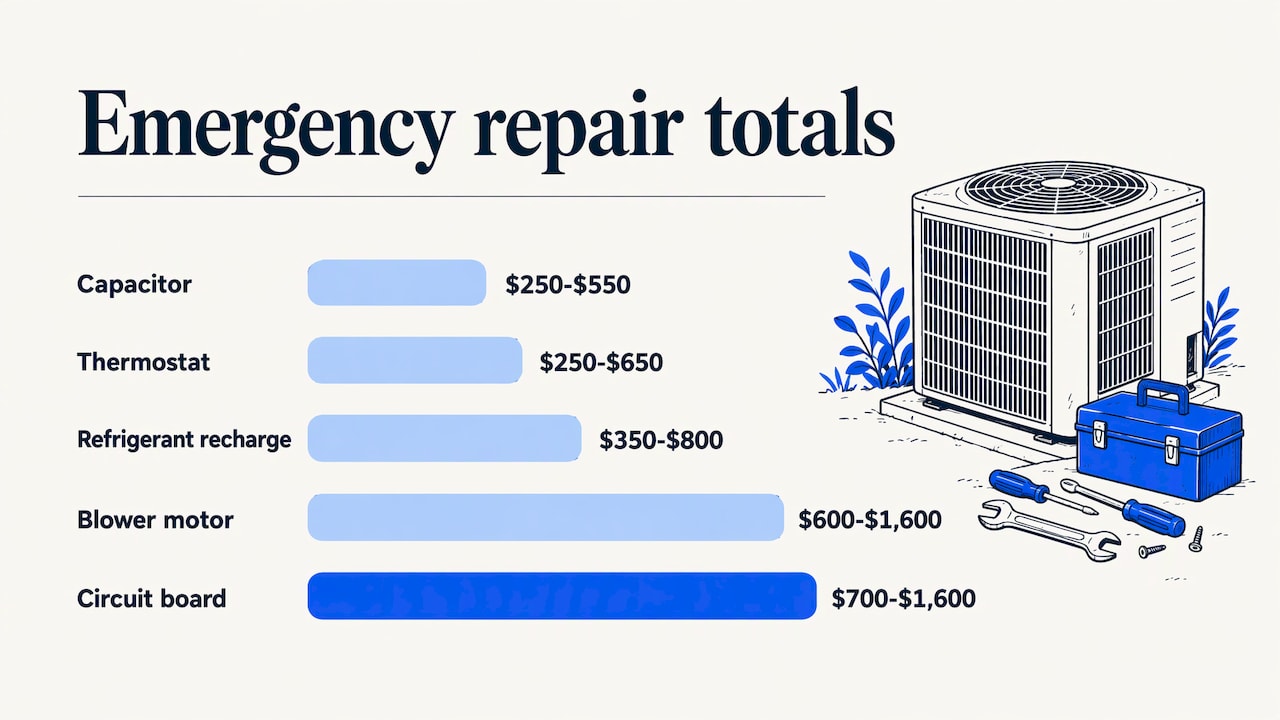
The part that failed decides most of the bill. These are after-hours totals, with fee, parts and labor included, from a March 2026 guide:
| Repair | Typical emergency-hours total |
|---|---|
| Capacitor replacement | $250 to $550 |
| Contactor | $250 to $550 |
| Thermostat | $250 to $650 |
| Refrigerant recharge | $350 to $800 |
| Blower motor | $600 to $1,600 |
| Circuit board | $700 to $1,600 |
Major component work sits above that. PICKHVAC lists major component repairs at $700 to $3,000, and compressor failures are the usual reason a bill climbs that high.
A useful detail from TrueRepairCost: on a capacitor (part about $9 to $45) or a contactor (about $10), the part is under 10% of the bill. You are paying for the trip and the labor. On fan motors and compressors, the part is a much larger share. That is why a quick fix at 11 pm can cost several times the price of the part and still be a fair invoice.
Is your broken AC an emergency?
Whether to pay the premium is a judgment about safety, not comfort alone. Some situations justify an immediate call:
- Someone in the home is an infant, an older adult, or has a medical condition that heat makes dangerous.
- Indoor temperatures are climbing toward unsafe levels with no way to cool a room.
- You smell burning, hear loud grinding or see smoke. Turn the system off at the thermostat and, if it is safe to reach, at the breaker, and call right away.
- The system is leaking water that threatens ceilings, flooring or electrical equipment.
- A business has refrigerated stock or equipment at risk.
If the house is safe and everyone is comfortable overnight, waiting for morning is a real option. PICKHVAC notes that a lower-urgency next-morning appointment can save the $50 to $200 after-hours surcharge, and TrueRepairCost gives the same rule of thumb for small repairs. In Florida summers, though, a house can warm quickly, so be honest about who is at home. Heat illness is a medical matter: if anyone shows signs such as confusion, fainting or a very high body temperature, call 911 first and the AC contractor second.
What pushes the final number up or down
Time of the call. Weeknight evenings cost less than 3 am Sunday. Holidays cost the most.
The failed part. A $20 part and a $1,900 compressor are different bills, even with the same technician.
System type and age. Older systems may need hard-to-find parts. Commercial and rooftop equipment generally costs more to service than a home’s central air.
Location. Remote addresses can add $50 to $200, and local labor rates vary.
Weather. On the hottest days, demand concentrates and rates rise.
Whether the fix is temporary or permanent. A tech may get you cooling tonight and schedule a fuller repair in daylight.
Repair or replace when the quote is high
A large emergency quote raises a fair question: is this system worth the money? When a compressor fails on an older unit, or repairs keep recurring, a replacement can make more sense than a third emergency visit. For Spring Hill homeowners, our AC replacement work is listed at $3,500 to $8,500 one-off on our AC replacement page. The final price depends on the home and system. We also offer financing options, so a failed system does not have to mean paying everything on the spot.
Our partnerships with top brands such as Trane and Lennox mean that if replacement is the right call, the new system is a quality one. You can read more on how that process works in our article on emergency air conditioning installation.
How to keep the call cheaper and the quote clear
When you are hot and tired, you are least able to question a bill. Settle these points on the phone, before anyone drives out:
- What is the call-out fee, and is it credited toward the repair?
- What is the hourly rate after the first hour, and is there a minimum?
- Will you get a written or texted estimate before work begins? You want the total, not a range that grows.
- What happens if the repair needs a part that is not on the truck?
- Is there any warranty on the labor and the part?
A contractor who answers these plainly is giving you the information you need to decide. It is also reasonable to approve a temporary fix tonight and schedule a larger repair for regular hours.
Keep the house cooler while you wait
While you wait for a technician, keep blinds closed on sun-facing windows, run fans, and avoid heat-producing appliances. Over the longer term, blocking sun at the window lowers the load on your system, and solar shades can reduce cooling costs by cutting the heat that enters in the first place.
The best way to avoid the emergency premium
The cheapest emergency repair is the one that never happens. Many after-hours failures, such as a worn capacitor, a dirty coil or a low-charge system, are found during a routine tune-up. That is why we offer maintenance plans for homes in Pasco, Hernando and Citrus counties. Regular service lets a technician catch wear on a normal weekday visit, when you are paying standard rates and not a premium.
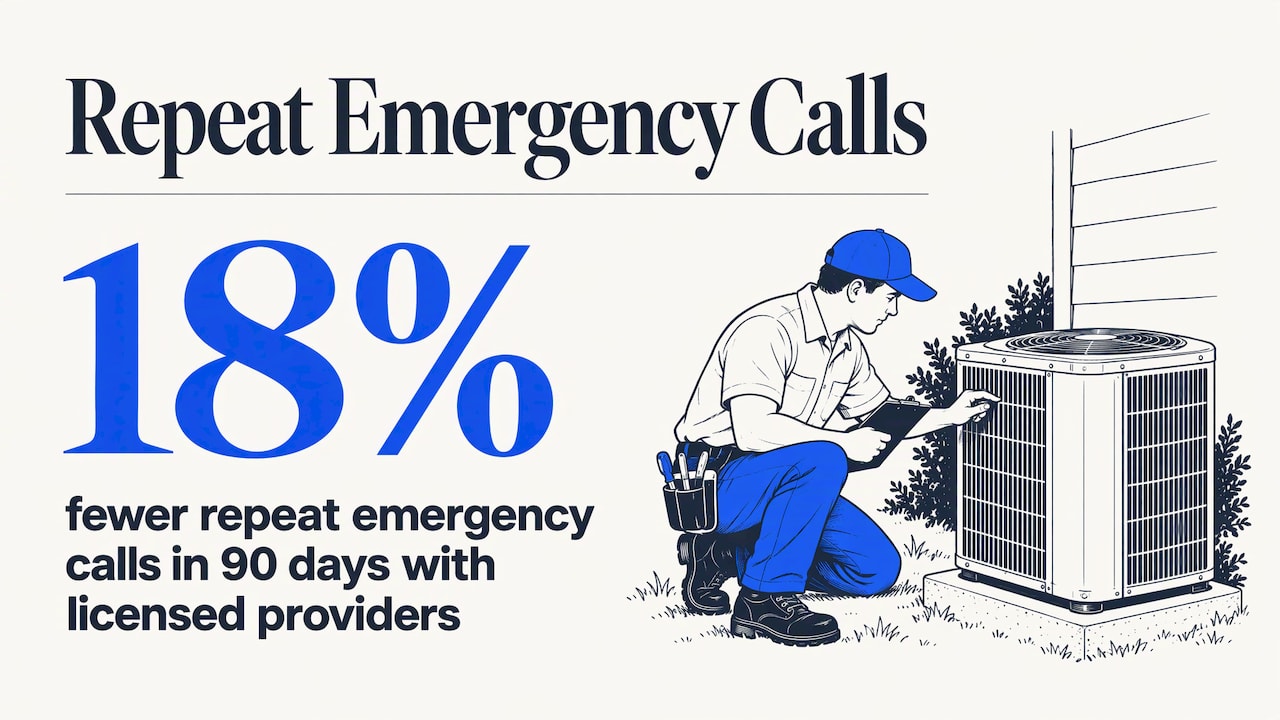
There is also evidence that qualifications matter. A 2024 industry study reported by Through Trade found that licensed, manufacturer-authorized providers had 18% fewer repeat emergency calls within 90 days. Fewer callbacks mean fewer bills.
Our perspective
We are a family-owned HVAC contractor, and our work rests on faith and integrity. When a family calls us in the middle of a Florida night, they are not shopping for the cheapest line item. They want to know the person at the door will tell them the truth about what is wrong and what it will cost.
That is why we hold to no hidden fees and no upsells. An emergency call is stressful enough without wondering whether the invoice will match the conversation. We explain the problem and the price in plain language, and we aim for the repair that fits your system and your budget.
We also believe the best emergency is a prevented one. Our maintenance plans exist so our customers can avoid the late-night breakdown in the first place, and when a system is truly at the end of its life, we work with brands like Trane and Lennox and offer flexible financing, so replacing it is manageable.
the author
When your AC fails, call us
We handle emergency AC service 24/7 for homes across Pasco, Hernando and Citrus counties. Our residential emergency AC service covers repairs at any hour, and businesses can reach us through our 24/7 commercial HVAC service, which includes refrigeration servicing. We do not publish a fixed emergency price, because the right figure depends on what has failed, so we give you the cost for your specific problem before work begins.

If you would like to understand how we approach urgent calls first, read our guide to fast emergency AC repair or our post on 24/7 AC repair in Hernando County.
FAQ
How much does emergency AC service cost?
Most US emergency AC visits total somewhere between $250 and $700 when the problem is a common one, and the broader range runs from about $150 to $1,500, per PICKHVAC’s 2026 guide. Major component repairs such as a compressor can reach $3,000. The call-out fee, hourly rate and the part are what move the number.
How much is an after-hours AC call?
The after-hours service call fee typically runs $150 to $350, compared with $75 to $250 for a standard daytime call, according to 2026 pricing data. Labor is billed on top, often at $125 to $250 per hour. Holidays and heat waves can push both higher.
Is a broken AC considered an emergency?
It is when heat puts someone at risk, such as an infant, an older adult or a person with a medical condition. It is also an emergency when you see smoke, smell burning, or have water leaking near electrical equipment. If the home is safe overnight, a morning appointment can save $50 to $200 in after-hours surcharges.
Can I get an estimate before the technician starts work?
Yes, and you should. Ask for the call-out fee, the hourly rate, any minimum and the total for the repair before approving anything. When we come out, we explain the problem and the price in plain terms first.
Sources
- Emergency HVAC Repair Cost in the U.S. 2026, PICKHVAC
- Air Conditioner Service Call Cost and Typical Repair Fees, PICKHVAC
- Emergency HVAC Cost: After-Hours Rates in 2026
- AC Repair Cost (2026): Prices for 12 Common A/C Repairs
- 24hr AC Repair Service Guide and Emergency Aircon Costs
- Maximizing Efficiency: How Solar Shades Reduce Cooling Costs
