Annual AC Maintenance: What to Schedule and When
Annual AC Maintenance: What to Schedule and When
Book one professional AC check-up every year, before the cooling season starts. That is the standard advice from ENERGY STAR, the U.S. EPA program, and it is the minimum for any central air system. In Florida, where the system works harder and longer than almost anywhere else in the country, the smartest way to keep that appointment is to put it on a recurring schedule so nobody has to remember it. That is what our maintenance plans for homeowners in Pasco, Hernando and Citrus counties are for.
This guide covers how often to service an air conditioner, the best time of year to do it, what a proper visit includes, what you can handle yourself in between, and how to tell when something has already gone wrong.
TL;DR
- Have a contractor check your cooling system once a year, in spring, before the heavy-use season.
- Between visits, inspect your air filter every month and clean or replace it as needed. Airflow problems can cut efficiency by up to 15 percent, according to ENERGY STAR.
- A real tune-up covers electrical connections, coils, refrigerant level, condensate drain, blower and controls. Ask for a written summary of what was done.
- Weak airflow, strange noises, constant running or ice on the refrigerant lines mean you need a repair call, not a wait-and-see.
- A recurring maintenance plan keeps the visit on the calendar so the first hot week does not become an emergency.
Table of Contents
- How often should an air conditioner be serviced?
- The best time of year to schedule service
- What a proper annual AC service includes
- What you can do yourself between visits
- Warning signs your AC needs service now
- Why annual maintenance pays off
- Homes and businesses: how the schedule differs
- Our perspective: make maintenance automatic
- Put your annual service on the calendar
- FAQ
- Sources
How often should an air conditioner be serviced?
Once a year is the baseline. ENERGY STAR recommends a contractor check-up annually, before the season: the cooling system in spring and the heating system in fall. If you have a heat pump or a furnace and air conditioner on the same ductwork, that means two visits a year, one for each side of the system.
There are a few reasons the number can go up:
- The system runs most of the year. Manufacturer guidance generally treats once a year as fine for most homes and suggests more frequent service where cooling runs for many months. Most of Florida fits that description. If your AC rarely switches off from spring through autumn, it is accumulating wear on the compressor, fan motors and capacitors far faster than a unit in a mild climate.
- Dust, pets or construction nearby. Dirty air clogs filters and coils faster, so inspections matter more.
- A commercial setting. A store, office or restaurant that cannot lose cooling for a day should treat maintenance as a scheduled operating cost, not an optional extra.
If you searched for a “maintenance schedule” or “yearly air conditioner maintenance,” the short answer is the same: one professional visit before the cooling season, monthly filter checks in between, and a second professional look if your system works year-round or you have noticed any change in how it performs.
Is a yearly service legally required?
For a typical home, no. Rules about refrigerant leak checks and inspections apply to much larger systems, mostly commercial equipment. For a house, annual service is a recommendation from ENERGY STAR and equipment makers. One related point is worth knowing: some manufacturer warranties expect proof that the system has been maintained, so keep every service record. Check your own warranty paperwork for the exact wording.
The best time of year to schedule service
Spring, ahead of the hot months. HVAC.com puts the ideal window at March or April, before the system’s first heavy use. It also points out that technicians get swamped by first-hot-day breakdowns once summer begins, while spring is a slower time when maintenance is easier to book.
For Florida homeowners the logic is even stronger. Our cooling season starts early and ends late, so by the time the first truly hot week arrives your system has already been running for weeks. A visit in late winter or early spring catches a weak capacitor or a clogged drain before the load gets heavy.
A simple calendar looks like this:
| When | What to do |
|---|---|
| Late winter to early spring | Professional AC tune-up before heavy use |
| Every month | Inspect the air filter, clean or replace as needed |
| Early summer | Clear the outdoor unit of leaves, grass clippings and debris |
| Fall | Heating system check if you have a heat pump or furnace |
| Anytime | Call for service if you notice any warning sign below |
If you already keep a seasonal to-do list for the house, an autumn home maintenance checklist is a good model for how to slot HVAC visits alongside other recurring tasks, so each one has its own place in the year.
What a proper annual AC service includes
Not every “tune-up” is equal. ENERGY STAR’s maintenance checklist describes what a contractor should do on a cooling check-up. Use it as your yardstick:
- Check thermostat settings to make sure the system cycles on and off as it should.
- Tighten electrical connections and measure voltage and current on the motors. Loose or corroded connections are a common cause of failed components.
- Lubricate moving parts to reduce friction, which wears motors and raises energy use.
- Inspect the condensate drain. This is the line that carries away the water the system pulls from your air. A blocked drain can back up and cause water damage or shut the system down.
- Check controls and the starting cycle to confirm the system starts, runs and stops correctly.
- Clean the evaporator and condenser coils. These are the heat-exchange surfaces inside and outside. Dirt on them makes the system work harder for less cooling.
- Check and adjust the refrigerant level according to the manufacturer’s specification.
- Clean and adjust blower components so air moves through the home properly.
The filter belongs on that list too. Between visits it is your job, but a good technician will look at it and tell you what they found.
What to ask for when the technician finishes
Three things turn a visit into something you can rely on:
- A written summary of what was checked, cleaned, measured and found. It is your record for warranty purposes and for tracking how the system changes year to year.
- Readings, not just “all good.” Voltage, amperage and refrigerant readings let you compare one year to the next.
- Separate quotes for any repair. If something needs fixing, you should see the problem explained and priced on its own, so you can decide without pressure.
That last point is where we put real effort. We built our name on honest, straightforward service with no hidden fees or upsells, and we explain what we find in plain language so you can decide with confidence.
A note on refrigerant
Refrigerant is not a consumable like oil in a car. A sealed AC system should hold its charge for years. If a technician says the system is low, the useful next question is where it is leaking, not whether to top it up. Refrigerant handling also requires certified technicians under federal rules, which is one more reason this is not a weekend project.
What you can do yourself between visits
The monthly routine is short, and it protects the system between professional visits.
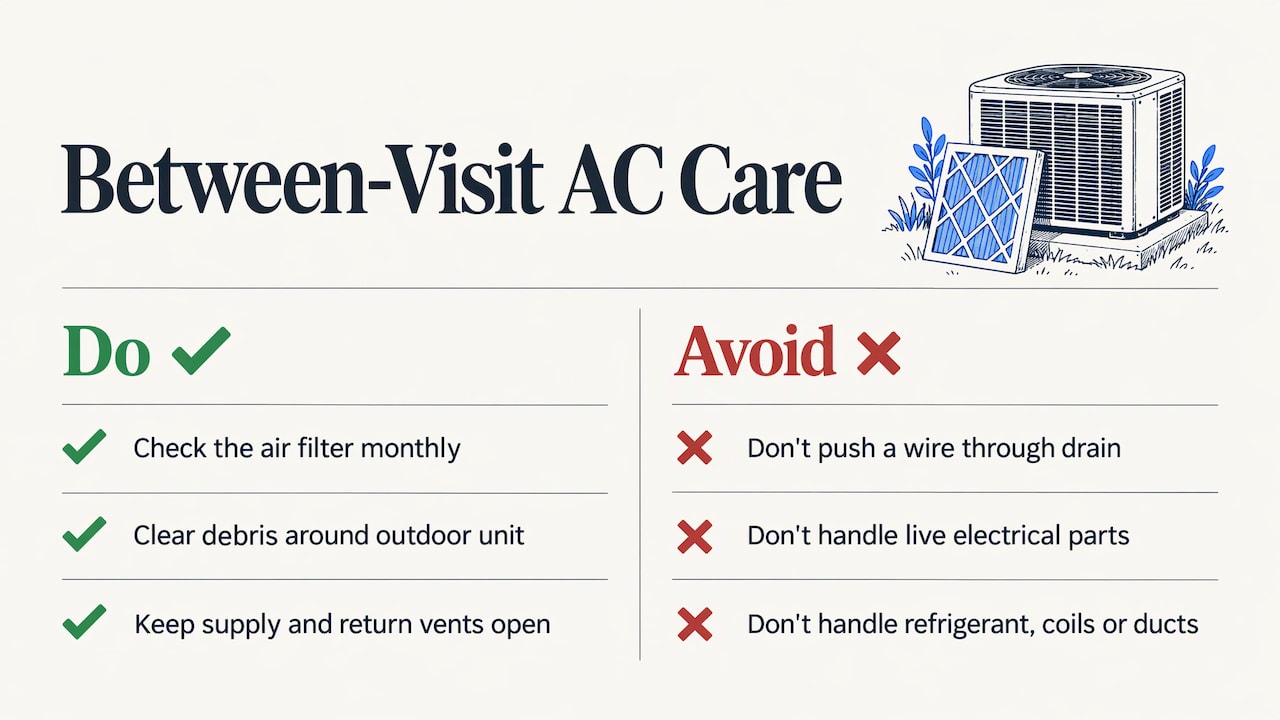
Check the air filter every month. ENERGY STAR advises inspecting, cleaning or changing filters once a month during heavy-use periods. Hold the filter up to a light. If you cannot see light through it, replace it. Homes with pets, shedding hair, renovation dust or allergies usually need a fresh filter more often. ENERGY STAR notes that airflow problems can reduce system efficiency by up to 15 percent, and a clogged filter is the most common cause.
Keep the outdoor unit clear. Trim plants back so there is room around the condenser, and remove leaves, grass clippings and debris from the cabinet. Never stack items against it. After a storm or a landscaping day, take a look.
Watch the drain. If you see water pooling near the indoor unit or notice a musty smell, the condensate line may be partly blocked. That is a call to us, not something to push a wire through.
Keep supply and return vents open. Furniture, rugs and closed registers choke airflow and make the system work harder.
That is the whole list. Everything involving electrical parts, refrigerant, coils inside the cabinet or ductwork belongs to a licensed technician. The parts are live, the pressures are real, and a wrong move can turn a $0 problem into an expensive one.
Warning signs your AC needs service now
An annual visit is a floor, not a ceiling. Call for service rather than waiting for the next scheduled check if you notice:
- Weak airflow from the vents, or rooms that no longer cool evenly
- Warm air or cooling that no longer keeps up on a normal day
- A system that runs constantly or turns on and off in short bursts (short cycling)
- Ice on the refrigerant lines or indoor coil
- New noises, such as grinding, squealing, buzzing or banging
- Musty or unpleasant odors from the vents
- A sudden rise in your electric bill without a change in how you use the home
Turn the system off if you see ice or water leaking, and call. Running a frozen system can damage the compressor, which is the most expensive part to replace.
We provide emergency AC service around the clock for homes and 24/7 emergency HVAC service for businesses, so a failure at night or on a weekend does not have to wait for Monday.
Why annual maintenance pays off
The benefits are practical, and they show up in three places.
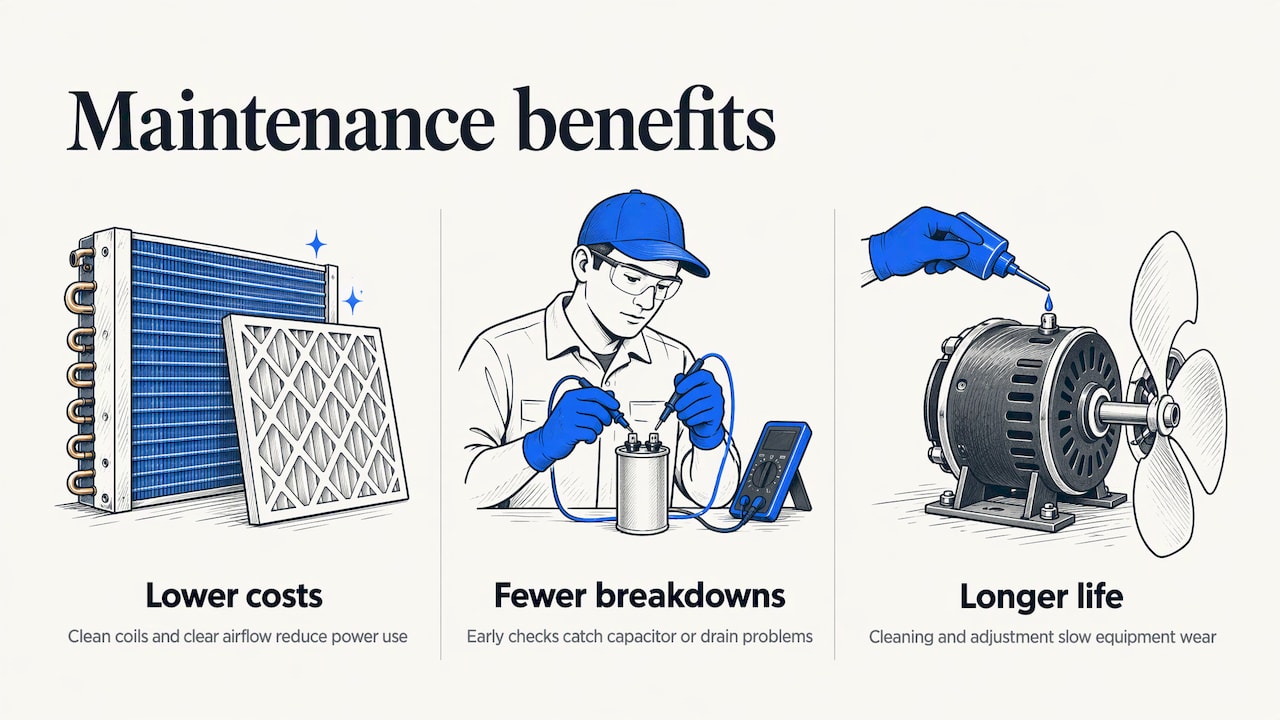
Lower running costs. Clean coils, a clear filter and correct airflow let the system deliver cooling without extra effort. A system that struggles pulls more power for the same result.
Fewer breakdowns. Many failures start small: a weakening capacitor, a loose wire, a clogged drain. A technician measuring electrical readings and checking the drain can find these before they stop the system. Spring service is meant to avoid the breakdown on the hottest day of the year.
A longer-lasting system. Equipment that is cleaned, lubricated and properly adjusted wears more slowly. That matters when a replacement is a major purchase. For reference, we list AC replacement in Spring Hill at $3,500 to $8,500 as a one-off project, and every year you add to the life of your current unit is a year you can plan that spending on your own terms.
There is also the record. A year-by-year log of what was checked and found makes it easy to see a trend, such as a reading that drifts, before it becomes a failure. It also supports any warranty claim.
Homes and businesses: how the schedule differs
Homeowners can follow the calendar above: spring tune-up, monthly filter check, a fall check if you also heat with the system.
Ductless and mini-split systems need the same annual professional visit, plus regular cleaning of the indoor unit filters. We have a guide on ductless AC maintenance if that is what you have.
Commercial properties add pressure. Higher run hours, more occupants and, in many cases, refrigeration equipment mean downtime costs money. We handle commercial HVAC repairs, new system installations, refrigeration servicing and 24/7 emergency service, so a business can keep cooling and refrigeration on one maintenance relationship rather than several. Details are on our commercial HVAC page.
Our perspective: make maintenance automatic
We are a family-owned company, and what we hear most often from customers is not “I skipped maintenance on purpose.” It is “I meant to call.” The AC worked fine in March, summer got busy, and the first call came when the house was already hot.
That is why we offer regular maintenance plans. A plan turns a good intention into a standing appointment. The point is to catch small problems quietly, so you avoid the emergency in the first place.
We also think the visit has to earn your trust. You should know what was checked, what was found and what, if anything, needs repair, with straightforward pricing and no hidden fees or upsells. Our faith and our family shape how we treat every customer, and honesty is part of the service.
We install and repair equipment from top brands including Trane and Lennox, and we know the Pasco, Hernando and Citrus county climate. That local knowledge shapes how we think about service timing for homes and businesses here.
the author
Put your annual service on the calendar
If your last professional check-up was more than a year ago, or you cannot remember it, the best time to book is before the next stretch of hot weather. Our maintenance plans are designed for homeowners who want the annual visit handled on a regular basis instead of remembered each spring.

If your system is already misbehaving, we repair air conditioners and offer emergency service at any hour through our residential services page. When a unit is past repair, we install and replace systems, and we offer flexible financing options. Our AC replacement page for Spring Hill gives the details for that area.
For more reading on routines and checklists, our blog has an air conditioning service checklist and a guide on HVAC maintenance for Pasco County homeowners.
FAQ
How often should an AC be serviced in Florida?
At least once a year, in spring before heavy use, which is the standard ENERGY STAR recommendation. Because Florida systems run for many months, a second look during the year is sensible, especially if you notice any change in cooling, noise or humidity. A maintenance plan keeps the visits scheduled.
Is it too late to service my AC once summer has started?
No. A service in the middle of the season still checks the electrical parts, coils, drain and airflow, and it can head off a failure. Spring is simply the easiest time to book, since technicians are busiest once the first hot spell hits.
Can I just change the filter and skip the professional visit?
The filter is the most important thing you can do yourself, but it covers only one item on the checklist. Electrical connections, coils, refrigerant level, the condensate drain and the blower all need a technician with the right tools and training.
What does an annual AC tune-up cost?
It depends on the system and the provider, and we do not publish a price for our maintenance plans. Contact us for a quote for your home or business. Ask for it in writing, along with a summary of what the visit includes.
