Condenser Fan Motor Repair: Costs, Signs and When to Call
Condenser Fan Motor Repair: Costs, Signs and When to Call
If the fan on top of your outdoor AC unit has stopped spinning, runs slowly or hums without turning, the fix is usually a capacitor or a motor swap that a trained technician finishes in one visit. Replacement typically runs a few hundred dollars. Running the system with a dead fan can cost far more, because the compressor depends on that fan to shed heat. At Reynolds Home Services, a family-owned HVAC contractor serving Pasco, Hernando and Citrus Counties, AC repair and 24/7 emergency service cover exactly this kind of call.
TL;DR
- The condenser fan motor pulls outdoor air across the coil so refrigerant can release heat. If it fails, the system stops cooling and the compressor is put at risk.
- Warning signs: a fan that won’t start or spins slowly, buzzing or grinding, a tripped breaker, warm air from the vents, and rising energy bills.
- Published cost guides put a full replacement at roughly $300 to $700 for parts and labor. A failed capacitor alone is a much smaller repair.
- Shut the system off at the thermostat and call a professional as soon as the fan stops, you smell burning, or the breaker trips repeatedly.
- Florida units run hard for most of the year, so a fan motor here works more months than in cooler states.
Table of Contents
- What the condenser fan motor does
- Signs the condenser fan motor is failing
- What happens if you keep running the AC with a dead fan
- Why capacitors fail first, and why it matters for your bill
- What a fan motor repair visit involves
- How much does condenser fan motor replacement cost?
- Repair or replace: the motor versus the whole system
- When to shut the system off and call
- How to keep the next fan motor from failing early
- Have the fan looked at by Reynolds Home Services
- Our view: fix the cause, not just the fan
- FAQ
- Sources
What the condenser fan motor does
Your outdoor unit, the condenser, is where your home’s heat leaves the building. Refrigerant carries heat out of your living space, and in the outdoor coil it has to condense from hot gas back into liquid. The fan blade on top of the unit, turned by the condenser fan motor, pushes outdoor air across that coil to make this happen. Inspectapedia’s technical reference describes the fan as the part that completes the heat transfer from indoors to outdoors, with high-pressure refrigerant gas entering the coil at around 100 psi and 95°F.
The motor is a small part doing a demanding job. It sits in the outdoor cabinet, exposed to heat, rain, humidity and debris, and in our climate it runs for much of the year.
Signs the condenser fan motor is failing
Fan motor trouble rarely arrives all at once. These are the symptoms homeowners report most often, and they match the lists in HVAC.com’s guide to failing fan motors and Forbes Home’s cost guide:
- The fan doesn’t start, or starts slowly. The compressor outside may hum while the blades sit still.
- Buzzing, rattling, grinding or squealing. Worn bearings are a common source of these noises.
- Intermittent operation. The fan runs for a while, stops, then runs again. A motor that overheats can shut itself off through an internal protector and restart once it cools.
- A burning smell or unexpected shutdowns. This points to overheating.
- Short cycling or a breaker that keeps tripping. A struggling motor can draw too much current.
- Warm air from the vents, longer cooling times or higher energy bills. The system is working harder to cool the house.
You don’t need to identify the cause yourself. What matters is noticing the symptom early, because the cheapest version of this repair is the one done before the compressor is stressed.
What happens if you keep running the AC with a dead fan
Without airflow across the coil, refrigerant can’t shed its heat. Pressure and temperature inside the system climb. According to Inspectapedia, when the condenser fan isn’t working the compressor may shut down or be ruined by overpressure or over-temperature. The compressor is the most expensive component in the outdoor unit.
So the practical rule is simple. If the outdoor fan is not turning while the system is calling for cooling, turn the air conditioner off at the thermostat and schedule service. Waiting a day in a Florida summer is uncomfortable, but it costs less than a damaged compressor.
Why capacitors fail first, and why it matters for your bill
Most residential condenser fans use a run capacitor, a small cylinder that gives the motor the electrical boost it needs to start and keep spinning. When it weakens, the motor hums but doesn’t turn, or turns slowly. A weak capacitor and a failing motor look almost identical from your yard.
That is why diagnosis matters. A technician measures the capacitor against its rated microfarads, spins the blade by hand to feel for stiff or grinding bearings, checks voltage at the motor, and compares the motor’s amp draw to the rating on its label. One technician guide notes that a capacitor can fail with no visible sign at all, so looking at it is never enough to rule it out.
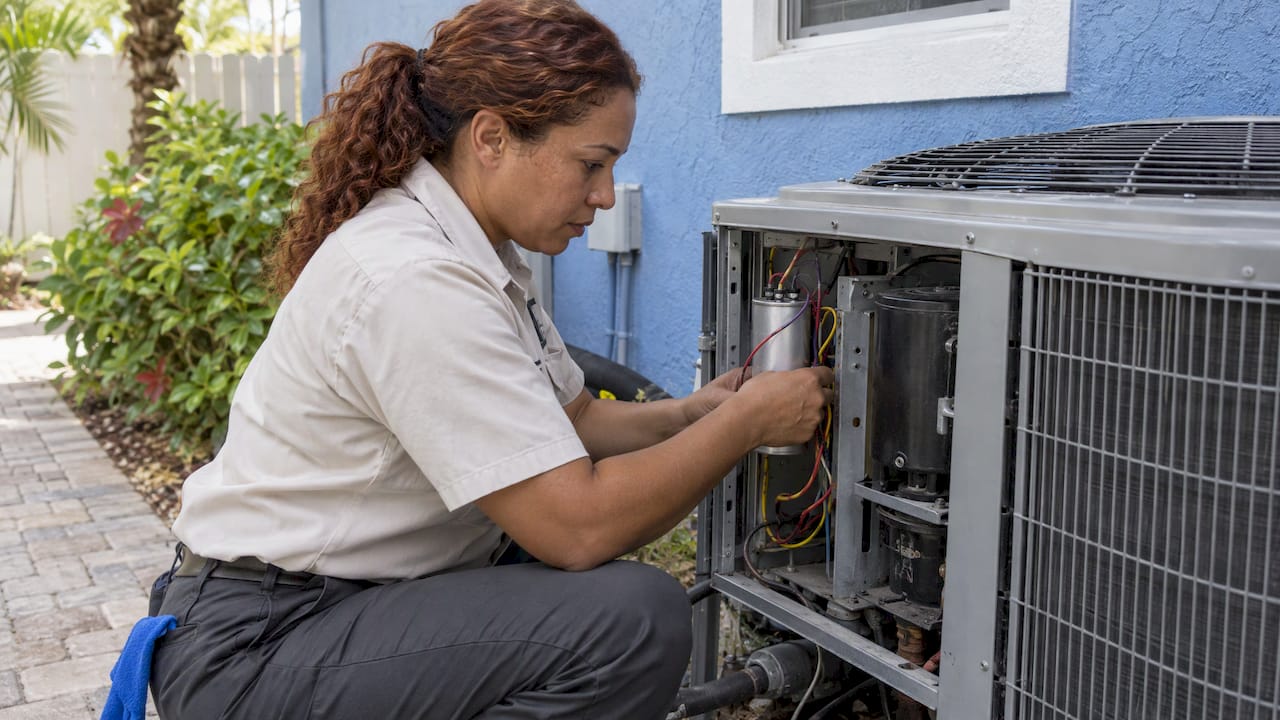
The result decides the bill. A capacitor swap is a small repair. A motor with burnt windings, a ground fault or seized bearings has to be replaced.
Why the capacitor is a job for a professional
The capacitor can store an electrical charge even after the power is switched off. Trade guidance such as ACHR News’s replacement walkthrough has technicians shut off power at the panel, pull the disconnect, confirm zero voltage with a meter and discharge the capacitor before touching any wires. That sequence exists because the unit runs on 240-volt power. If you suspect a fan problem, the safe thing for you to do is switch the system off at the thermostat and leave the panel closed.
What a fan motor repair visit involves
A proper visit has a clear order of work, and it should be explained to you as it happens:
- Power off and lockout. The technician cuts power at the disconnect and confirms it with a meter.
- Diagnosis. Capacitor reading, blade rotation by hand, voltage at the motor leads and amp draw against the nameplate. The failure mode decides whether the fix is a capacitor or a motor.
- Matching the replacement. A new motor has to match the original on voltage, rpm, horsepower, frame size and rotation direction. Mismatched rpm or an undersized horsepower rating leads to poor airflow or early failure.
- Installation. The motor is mounted to the condenser cover grate, the blade is set at the right height and the wiring is reconnected the way it came off.
- Capacitor replacement. ACHR’s guidance is that best practice is to install a new capacitor whenever a fan motor is replaced, with a microfarad rating that matches the motor.
- Verification. After the repair, amp draw should be within about 10% of the nameplate value and air should be moving up through the top of the unit.
The matching and verification steps are where repairs go wrong when they are rushed. A motor that spins is not the same as a motor that is correctly sized, wired and checked under load. We handle that full sequence on every fan motor call, so you get a system that is cooling again, not just a fan that is turning.
How much does condenser fan motor replacement cost?
Homeowners searching for AC fan motor replacement cost usually want a number before they call. National cost guides give a workable range, with the caveat that figures differ by region, brand and motor type.
| Cost item | Typical range | Source period |
|---|---|---|
| Complete replacement, parts and labor | $300 to $700 | March 2026 cost guide |
| Motor itself, OEM (manufacturer-original) | $150 to $350 | March 2026 cost guide |
| Motor itself, universal or aftermarket | $75 to $200 | March 2026 cost guide |
| Labor, one to two hours | $150 to $350 | March 2026 cost guide |
| Motor material cost, broader range | $200 to $700 | This Old House, March 2026 |
The same guide breaks the total down by motor type: roughly $300 to $550 for a single-speed motor, $400 to $700 for a two-speed and $500 to $900 or more for a variable-speed ECM motor. These are national published figures from 2026, not quotes, and they move with parts pricing and local labor rates.
What pushes your price up or down:
- Motor type. Variable-speed systems use more expensive motors.
- Capacitor condition. If the capacitor is the only problem, the repair is far smaller than a motor replacement.
- Timing. The cost guide above lists emergency service as adding $75 to $200. Calling at the first symptom, not after a night of lockout, tends to avoid that.
- Other damage. A fan that ran strained for weeks can leave other components worn.
We don’t publish a flat price for fan motor repair, because the right quote depends on what the diagnosis finds. Our approach is to tell you what is wrong and what it costs before work starts, with no hidden fees or upsells.
Repair or replace: the motor versus the whole system
Two different questions get mixed together here.
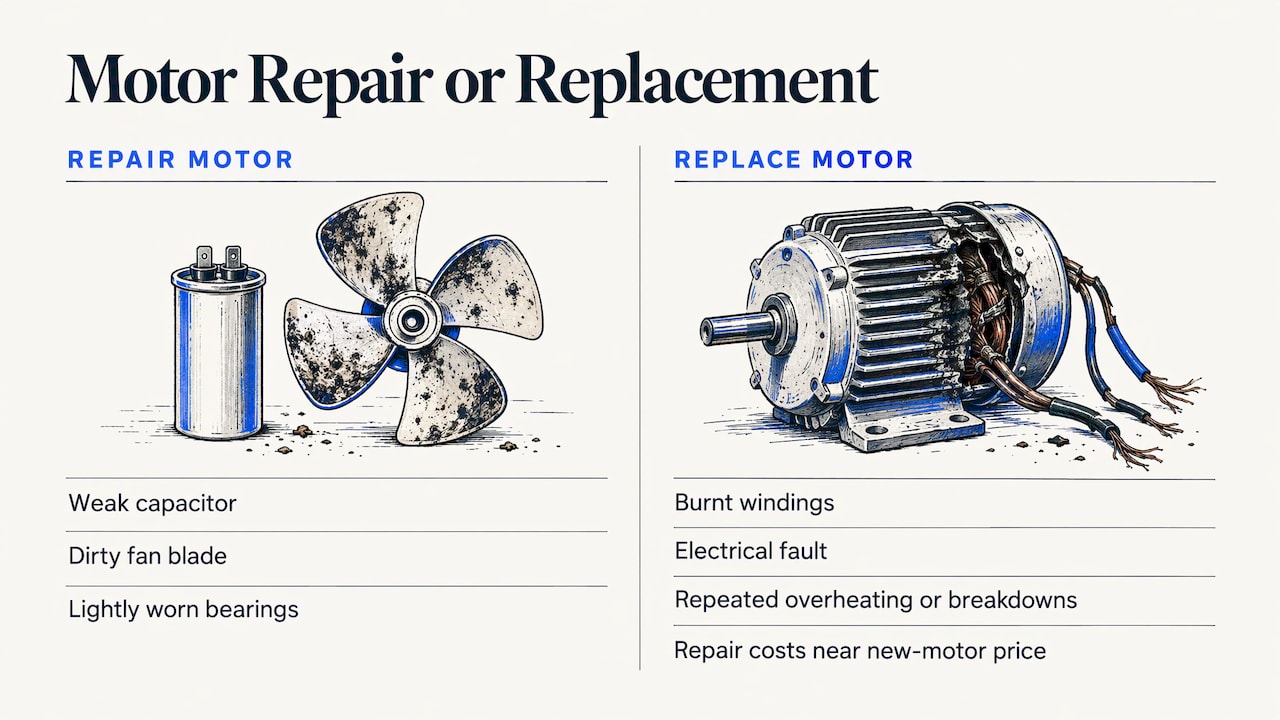
Motor repair versus motor replacement. A motor with a weak capacitor, dirty blade or lightly worn bearings can often be put right. One with burnt windings, an electrical fault, repeated overheating or repeated breakdowns is replaced. Parts retailers’ guidance, such as PartsHNC’s troubleshooting article, also points to replacement when repair costs approach the price of a new motor.
Fan motor versus whole AC replacement. If the unit is young and otherwise healthy, a fan motor is a sensible repair. If your system is old, has a history of repairs, or the compressor has already been stressed by a failed fan, it’s worth asking whether the money is better spent on a new system. Our guide to making the right AC replacement decision walks through that thinking, and our HVAC financing options are there if a replacement turns out to be the better path.
When to shut the system off and call
Some situations can’t wait for a convenient appointment. Turn the AC off at the thermostat and call us when:
- The outdoor fan is not spinning while the compressor hums or the system is trying to run.
- You smell burning near the outdoor unit or the air handler.
- The breaker trips more than once. Don’t keep resetting it. A repeatedly tripping breaker means something is drawing too much current.
- The unit shuts off by itself and restarts later, which can mean a motor overheating and cycling on its protector.
- Indoor air is blowing warm and the house isn’t cooling, even though the thermostat is calling for it.
In each case, switching off the system protects the compressor and gives the technician a cleaner starting point. Don’t open the electrical panel on the unit. A capacitor can hold a charge, and the unit runs on 240 volts. Florida summer heat adds urgency, so we offer emergency AC service around the clock across Pasco, Hernando and Citrus Counties. Businesses with failed condenser fans on commercial or refrigeration equipment can reach our 24/7 commercial HVAC team.
How to keep the next fan motor from failing early
Fan motors last a long time when they are looked after. HVAC.com notes that AC fan motors can last 10 to 15 years or more, but lack of maintenance shortens that. Summer is also when failures peak, since motors run at maximum load in the hottest weather.
A routine maintenance visit is where a weakening capacitor, a drying bearing or an overheated motor gets noticed while it’s still a small job. Our maintenance plans exist so that homeowners avoid the emergency in the first place. If you want a visit before the busy season, booking HVAC tune-ups early in the shoulder season gives you a wider choice of appointment times.
Between visits, keep the area around the outdoor unit clear of leaves, grass clippings and stored items so air can move freely, and don’t spray water into the cabinet. If something sounds different, such as new grinding or a slower fan, treat that as a reason to book a visit, not as a quirk to live with.
Have the fan looked at by Reynolds Home Services
If your outdoor fan is slow, silent or noisy, we’ll find out whether it’s a capacitor, a motor or something else, and explain the options before work begins. We’re a family-owned HVAC contractor serving homes and businesses in Pasco, Hernando and Citrus Counties, and we work with brands including Trane and Lennox. You can start with AC repair or reach our emergency line through the residential services page.

If the diagnosis shows the system is near the end of its life, we also install replacements. In Spring Hill, AC replacement is published at $3,500 to $8,500 as a one-off cost, and financing is available.
Our view: fix the cause, not just the fan
A condenser fan motor is one of the cheaper parts in your air conditioner and one of the most expensive to ignore. We say that because the fan is what protects everything else in the outdoor unit.
When we get a call about a fan that won’t turn, we want to know why. A weak capacitor, a worn bearing and a burnt winding each have a different fix, and a different cost. Swapping parts without finding the cause is how families end up calling twice in the same summer.
Our approach is honest, straightforward service. We tell you what we found, what it takes to fix it and what it costs, and we don’t pad the visit with upsells. We’re a family-owned company built on faith and integrity, and that is how we want to treat every household and business in the three counties we serve.
We also believe the best repair is the one that never becomes an emergency. That’s why we offer regular maintenance plans: a technician who looks at your system on a schedule catches the tired capacitor in spring instead of the dead fan in August.
the author
FAQ
How much does it cost to repair a condenser fan?
Published national guides put a full motor replacement at about $300 to $700 including parts and labor, with a March 2026 cost guide listing $150 to $350 for an OEM motor. If only the capacitor has failed, the repair is smaller. Contact us for a quote based on your unit’s diagnosis.
Can I keep running my AC if the condenser fan isn’t working?
No. Without the fan, refrigerant can’t release its heat, and the compressor can overheat or be damaged from overpressure, according to Inspectapedia. Turn the system off at the thermostat and call for service.
Is it the capacitor or the motor?
The symptoms overlap. A humming fan that won’t spin can be either one, and a capacitor can fail without any outward sign. A technician measures the capacitor and the motor’s amp draw to tell them apart, which is why a proper diagnosis comes before any parts are replaced.
How long should a condenser fan motor last?
HVAC.com reports that AC fan motors can last 10 to 15 years or more, and that poor maintenance shortens that life. Regular tune-ups help catch problems early.
Sources
- Diagnose & Repair AC Condenser Unit Fan, Inspectapedia
- How Much Does Condenser Fan Motor Replacement Cost? Forbes Home
- AC Fan Motor Replacement: Signs It’s Going Bad, HVAC.com
- How to Safely and Accurately Replace a Condenser Fan Motor, ACHR News
- Condenser Fan Motor Troubleshooting: A Step-by-Step Diagnostic Guide
- Condenser Fan Motor Replacement Cost (2026)
- How Much Does AC Condenser Replacement Cost? This Old House
- AC Condenser Fan Motor Troubleshooting: How to Fix, PartsHNC
