Evaporator Coil Repair: What Can Be Fixed, What It Costs
Evaporator Coil Repair: What Can Be Fixed, What It Costs
Some evaporator coil problems can be repaired, and many cannot. A dirty coil can be cleaned. A damaged copper tube or joint that a technician can reach may be repaired. Corrosion and leaks inside the fin pack usually mean the coil has to be replaced. Which of those you have is decided by a proper diagnosis, and a licensed contractor should make it. If you live in Pasco, Hernando or Citrus County, our AC repair team can diagnose the coil and tell you plainly whether repair, coil replacement or a new system is the sensible call.
TL;DR
- The evaporator coil is the indoor part of your AC that pulls heat and moisture out of your home’s air. When it fails, you get warm air, weak airflow, ice or water leaks.
- Accessible tube or joint damage can sometimes be repaired. Corrosion and fin-pack leaks generally call for replacement.
- Published 2026 manufacturer estimates put coil replacement anywhere from about $1,000 to $5,000 or more, depending on warranty, labor, refrigerant and system.
- If the coil is frozen, switch the thermostat from Cool to Off and call your HVAC company. Do not chip the ice.
- On an older system, replacing the coil and outdoor unit together can protect your investment better than a coil alone.
Table of Contents
- What the evaporator coil does
- Signs the coil may need repair
- If your coil is frozen
- How a technician diagnoses the coil
- What can be repaired and what cannot
- What evaporator coil repair and replacement cost
- Repair the coil, replace the coil, or replace the system
- Protecting the coil afterward
- Who to call in Pasco, Hernando and Citrus County
- Our view on evaporator coil repair
- FAQ
- Sources
What the evaporator coil does
Your air conditioner moves heat from inside your house to the outdoors. The evaporator coil is the indoor half of that job. Warm indoor air passes over its fins, and the refrigerant inside the coil absorbs that heat and boils into vapor. The vapor then carries the heat to the outdoor compressor, as the American Society of Home Inspectors explains. The coil also pulls moisture out of the air, which is why it sits above a drain pan.
In Florida, where systems run most of the year, the coil works hard. Humidity, dust and long run times all put wear on it. Manufacturers say coils typically last 10 to 15 years with regular maintenance, so the coil in a well-kept system often outlasts a neglected one by years.
Signs the coil may need repair
The coil sits inside the air handler, so you rarely see it. You notice its symptoms instead. Trane lists the following as possible signs of a coil problem:
- Weak airflow from the vents
- Warm air while the system is in cooling mode
- Rooms that will not hold an even temperature
- Hissing or gurgling sounds
- Oily residue near the coil
- A frozen coil
- Higher energy bills with no other explanation
The same guide cautions that other faults can cause similar symptoms. A failing capacitor, a dirty filter or a weak blower can all make a house feel warm. That is why guessing is expensive. If you want to work through the basics first, this walkthrough on what to check when an air conditioner is not cooling covers the common causes.
Water is its own warning. The home inspectors’ guidance says water leaks at the evaporator coil warrant further evaluation. A clogged drain line is a common cause, but a leak at the coil itself is possible too, and water inside an air handler can lead to damage and mold. If you see moisture on or around your vents, this guide to condensation on AC vents and mold explains what to look for.
If your coil is frozen
A frozen coil is the most common reason homeowners start searching for coil repair. Ice on the coil blocks airflow, and the system keeps running while it cools less and less.
Do not keep running it. Trane’s guidance is that running the system with a frozen coil can cause major damage. Here is what to do:
- Set the thermostat from Cool to Off. You can run the fan alone if your thermostat allows it, which helps the ice melt.
- Do not chip, scrape or hammer the ice. The fins and tubing are thin and easily punctured.
- Call your HVAC company.
Ice is a symptom, not the disease. Trane’s guide says dirty filters, blocked return vents, a dirty coil and refrigerant leaks can all contribute to icing. Changing the filter every 30 to 90 days and keeping return vents clear are the simple preventive steps. If the ice returns after the coil thaws, the cause is probably something a technician needs to find, such as low refrigerant from a leak.
Because HVAC equipment carries high-voltage and refrigerant hazards, manufacturer guidance advises homeowners not to open or handle internal coil components. Leave the access panel to a licensed technician.
How a technician diagnoses the coil
A good diagnosis does not start with the coil. It starts with the whole system, because a low charge, poor airflow or a bad expansion valve can imitate a coil failure.
The U.S. Department of Energy’s air conditioner diagnostics guide calls for checking airflow and measuring superheat and subcooling. These are temperature-and-pressure readings that show how the refrigerant is behaving in the system. The guide also warns that defects other than an incorrect charge can mislead a charge diagnosis. In plain terms: adding refrigerant to a system without finding out why it is low just hides the problem for a few weeks.
A comprehensive diagnosis, according to DOE guidance on airflow and charge verification, includes:
- A visual inspection
- Airflow and temperature-split measurements
- Superheat and subcooling readings
- Retesting after repairs
If a leak is suspected, the technician locates it with an electronic detector, UV dye or a bubble solution, and may follow with a pressure test. The retest at the end is the part worth asking about. It shows the fix worked, not just that the system started.
For a sense of what refrigerant loss looks like from the homeowner’s side, this article on AC refrigerant leak signs and airflow checks is a useful companion.
What can be repaired and what cannot
This is the question behind most coil searches. The honest answer depends on where the damage is.
| Coil condition | Usually means |
|---|---|
| Dirt or fouling on the coil | Cleaning can address it |
| Damage to accessible copper tube or a joint | May be repairable |
| Corrosion | Generally replacement |
| Leak within the fin pack | Generally replacement |
| Leak inside a coaxial coil | Generally replacement |
This follows technical reporting in ACHR News, an HVACR trade publication, which says corrosion and leaks internal to coaxial coils or within fin-pack areas are not considered repairable. The same article quotes a manufacturer’s technical manager recommending a good-faith repair effort when a coil is repairable and has several useful years left. Another engineer in the article notes that repair is often less expensive than replacement, but that success depends on coil construction, the technician’s skill and the type of failure.
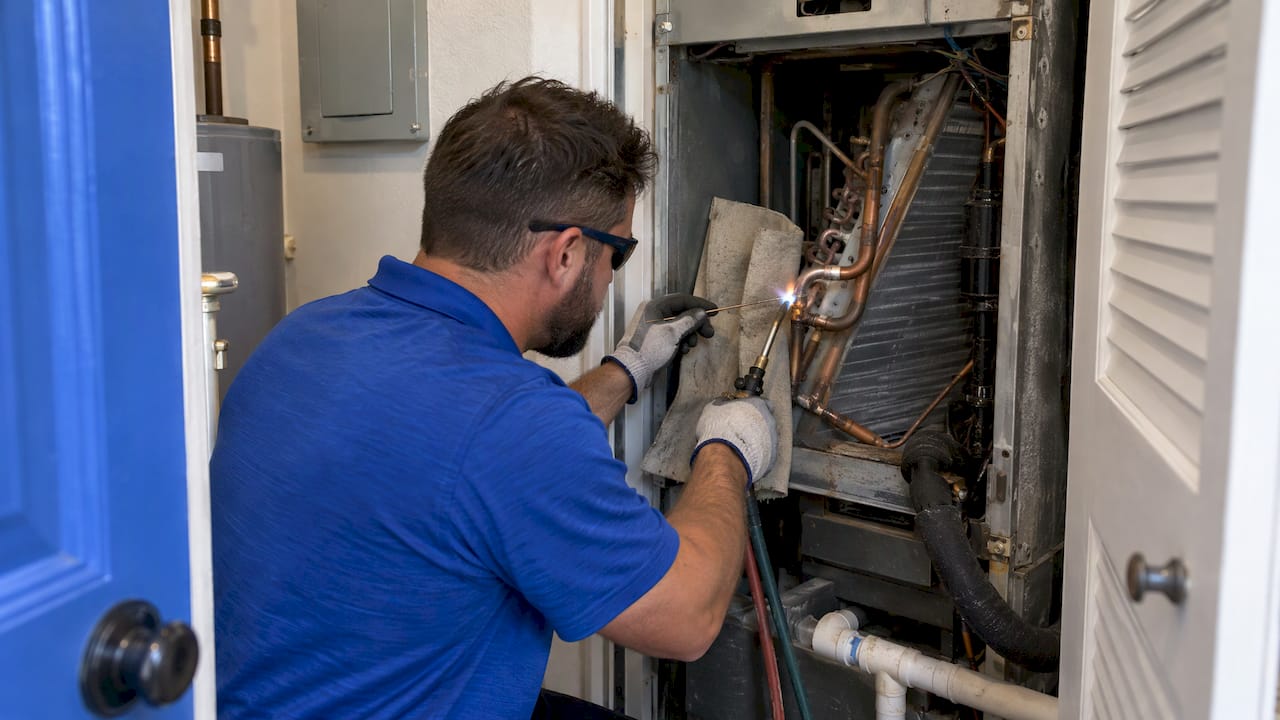
That last point matters. A repair on a coil is a precise brazing job on thin metal in a tight space. It is worth hiring a contractor who will tell you straight whether the repair will last, rather than one who patches and moves on.
What evaporator coil repair and replacement cost
Because most coil work ends up as replacement, published prices mostly cover replacement. Prices also vary a lot, and no honest figure fits every house.
Two published manufacturer estimates show the spread:
- Trane’s April 2026 coil guide estimates replacement at $2,000 to $5,000 or more when the system is out of warranty.
- Trane’s May 2026 repair cost guide lists evaporator coil repair or replacement at $1,000 to $5,000 or more.
These are published estimates, not quotes, and they change as parts and labor costs change. What moves your number:
- Warranty. A warranty may cover the coil itself, but labor, refrigerant, taxes and other charges can remain your responsibility.
- Location and service-call charge. Both feed into the total.
- Repair complexity and labor. Coil replacement is labor-intensive work.
- Emergency timing. After-hours calls can cost more.
- System age and parts availability. Older systems and older refrigerants can make a compatible coil harder to find.
The practical advice is to get the quote itemized: the coil, the refrigerant, the labor, and any other charge, each on its own line. Then you can compare the same work, not just a bottom-line number.
Repair the coil, replace the coil, or replace the system
This is where a coil bill can turn into a bigger decision. There is no single rule, but the published guidance points the same direction.
Age is the first filter. Trane’s guide on repair versus replacement says replacement merits consideration for systems older than 10 years, with costly or frequent repairs, an expired warranty, rising energy bills or low efficiency. It says repair is often more cost-effective for systems under 10 years old. A separate Trane guide notes that a system nearing roughly 15 years of service may be more cost-effective to replace whole.
Matching matters. The indoor coil and outdoor unit are designed to work as a pair. The Department of Energy’s guide says that when a condenser is replaced, the indoor coil and expansion valve are typically replaced as well, and that system and coil sizing should be reassessed. Trane recommends compatible indoor and outdoor components, so a coil that does not match the outdoor unit can cost you efficiency and comfort.
A simple way to think about it:
- Under about 10 years old, good outdoor unit, coil damage is localized and reachable. Repair or coil replacement is usually the sensible route.
- Under warranty. Use it. Ask what labor and refrigerant charges remain.
- 10 years or older, with other repairs piling up. Price a matched coil-and-outdoor-unit replacement alongside the coil-only quote.
- Around 15 years old. The coil bill is probably better spent toward a new system.
If the numbers point toward replacement, our AC replacement page for Spring Hill lists a one-off range of $3,500 to $8,500. You can also read our guide on making the right AC replacement decision before you commit either way.
Protecting the coil afterward
A coil rarely fails for no reason. Most of the causes are things a routine visit catches early: dirt building up on the fins, a restricted drain, a slow refrigerant leak, airflow that has dropped. The manufacturer’s icing guidance mentions the same triggers, and its preventive steps are changing filters every 30 to 90 days, keeping returns clear and scheduling service.
That is the logic behind a maintenance plan. A technician who cleans, measures and checks the drain twice a year is looking at the same readings used in a diagnosis, before the system fails on a hot afternoon. Our maintenance plans are built around that approach, and you can browse our HVAC maintenance articles for seasonal checklists.
Who to call in Pasco, Hernando and Citrus County
A coil problem in a Florida summer is not something to leave for next week. The ice builds, the humidity climbs and the compressor takes the strain. Reynolds Home Services is a family-owned HVAC contractor serving Pasco, Hernando and Citrus Counties. We repair and replace residential systems, offer emergency AC service around the clock, and work with Trane and Lennox equipment. If you run a business, our commercial team handles repairs, installations, refrigeration and 24/7 emergency HVAC service.
We do not charge hidden fees or push upsells. When we look at a coil, we tell you what is wrong, what the options are and what each costs, so the decision is yours and you have the facts. If a larger job is the right answer, flexible financing is available, and you can see the details on our financing page.
If your AC is warm, weak or iced over, call us through our main site and we will diagnose the problem and give you the options.

Our view on evaporator coil repair
We get a lot of calls that start with someone who has already been told the coil is bad. Sometimes it is. Often the real story is airflow, a clogged drain or a refrigerant issue, and the coil is the part that shows the damage.
Our approach is the one we would want for our own families. Find the cause first. Say plainly whether the coil can be repaired or needs replacing. Put the options in front of you with honest numbers, no hidden fees and no upsells. We are a family-owned company, and our work is rooted in faith and integrity. That is why we explain the repair-versus-replace choice rather than just handing over a total.
We also believe the best coil repair is the one you never need. Regular service plans keep the coil clean and the drain clear, and they help you avoid the emergency call in the middle of a Florida summer. When a system is truly at the end of its life, we will tell you that too, and we can show you matched Trane or Lennox options and the financing that goes with them.
the author
FAQ
Can a leaking evaporator coil be repaired?
Sometimes. Damage to an accessible copper tube or joint may be repairable. Corrosion and leaks within the fin pack are generally treated as replacement jobs, according to ACHR News. A technician needs to locate the leak before anyone can say which applies to your coil.
How much does it cost to replace an evaporator coil?
Published manufacturer estimates run from about $1,000 to $5,000 or more, depending on warranty, labor, refrigerant, location and system age. Trane’s 2026 guides give $2,000 to $5,000 or more out of warranty. Ask for an itemized quote so you can see each charge.
Can I run my AC with a frozen coil?
No. Running the system with a frozen coil can cause major damage. Turn the thermostat from Cool to Off, leave the ice alone and call your HVAC company. Changing the filter and keeping return vents open helps prevent a repeat.
Should I replace just the coil or the whole system?
On a system under about 10 years old, replacing only the coil is often cost-effective. Past 10 years, or near 15, with other repairs adding up, a matched system is worth pricing. The coil and outdoor unit work as a pair, so compatibility matters either way.
Sources
- American Society of Home Inspectors: Air Conditioning, What You Can’t See
- Trane: What Is an Evaporator Coil
- Trane: What Does Evaporator Coil Replacement Cost?
- Trane: Average Central Air Conditioning Repair Cost
- Trane: What To Do If the AC Evaporator Coil Is Frozen
- Trane: AC Replacement or AC Repair
- U.S. Department of Energy: Measure Guideline, Air Conditioner Diagnostics
- U.S. Department of Energy: Guidelines on Airflow and Refrigerant Charge Verification
- ACHR News: Balancing Customer Cash Flow with Proper Procedure
- Fix It Daily: Air Conditioner Not Cooling? What to Check
- AC Refrigerant Leak Signs: Check Airflow First
- Ready 2 Inspect: Condensation on AC Vents
